

As a supplier of epoxy laminate sheets, I often encounter inquiries about the thermal conductivity of these materials. Thermal conductivity is a critical property that determines how well a material can conduct heat. In this blog post, I will delve into the concept of thermal conductivity, its significance in epoxy laminate sheets, and the factors that influence it.
Understanding Thermal Conductivity
Thermal conductivity, denoted by the symbol λ (lambda), is a measure of a material's ability to conduct heat. It is defined as the quantity of heat (in watts) that passes through a unit area (in square meters) of a material in a unit time (in seconds) when there is a unit temperature gradient (in kelvin per meter) across the material. The SI unit for thermal conductivity is watts per meter-kelvin (W/(m·K)).
A material with high thermal conductivity will transfer heat quickly, while a material with low thermal conductivity will act as an insulator, resisting the flow of heat. For example, metals like copper and aluminum have high thermal conductivity values (around 400 W/(m·K) for copper and 200 W/(m·K) for aluminum), which is why they are commonly used in heat sinks and other applications where efficient heat transfer is required. On the other hand, materials like glass and plastic have much lower thermal conductivity values, making them suitable for insulation purposes.
Thermal Conductivity of Epoxy Laminate Sheets
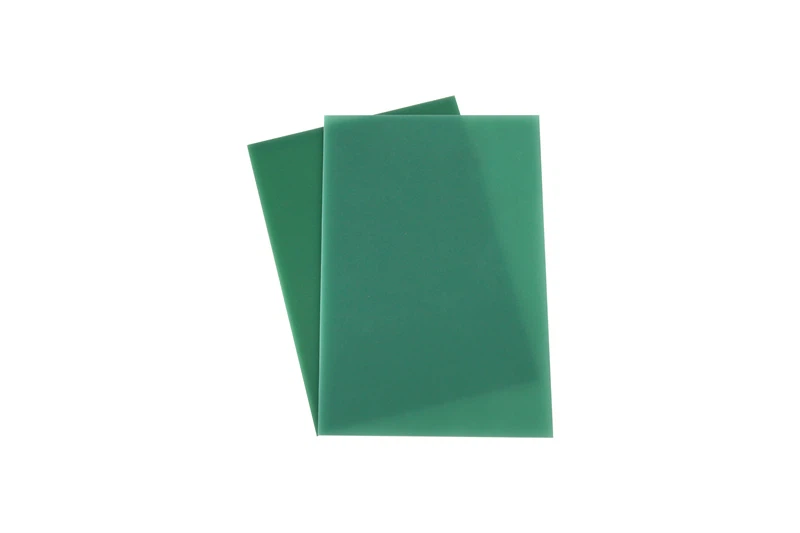
Epoxy laminate sheets are composite materials made by impregnating layers of fiberglass or other reinforcement materials with epoxy resin and then curing them under heat and pressure. These sheets are widely used in various industries, including electrical, electronics, and mechanical engineering, due to their excellent mechanical, electrical, and thermal properties.
The thermal conductivity of epoxy laminate sheets typically ranges from 0.2 to 1.0 W/(m·K), depending on several factors such as the type of reinforcement material, the resin system, the thickness of the sheet, and the manufacturing process. Compared to metals, epoxy laminate sheets have relatively low thermal conductivity, which means they are better insulators. However, in some applications, such as printed circuit boards (PCBs) and electrical insulation components, a moderate level of thermal conductivity is required to dissipate heat generated by electronic components.
Factors Influencing the Thermal Conductivity of Epoxy Laminate Sheets
Reinforcement Material
The type and amount of reinforcement material used in the epoxy laminate sheet have a significant impact on its thermal conductivity. Fiberglass is one of the most commonly used reinforcement materials in epoxy laminate sheets due to its high strength, low cost, and good electrical insulation properties. However, fiberglass has relatively low thermal conductivity, typically in the range of 0.3 - 0.5 W/(m·K). As a result, epoxy laminate sheets reinforced with fiberglass also have low thermal conductivity.
In contrast, carbon fiber has a much higher thermal conductivity, ranging from 10 to 200 W/(m·K), depending on the type and orientation of the fibers. Epoxy laminate sheets reinforced with carbon fiber can have significantly higher thermal conductivity compared to fiberglass-reinforced sheets. However, carbon fiber is more expensive than fiberglass, and its high electrical conductivity may not be suitable for applications where electrical insulation is required.
Resin System
The resin system used in the epoxy laminate sheet also affects its thermal conductivity. Epoxy resins are known for their excellent adhesion, chemical resistance, and electrical insulation properties. However, different epoxy resin formulations can have different thermal conductivity values. For example, some high-performance epoxy resins are formulated with additives or fillers to improve their thermal conductivity. These additives can include ceramic particles, metal powders, or carbon nanotubes, which can increase the thermal conductivity of the resin system.
Thickness of the Sheet
The thickness of the epoxy laminate sheet can also influence its thermal conductivity. In general, thicker sheets have lower thermal conductivity compared to thinner sheets. This is because heat has to travel a longer distance through the material, which increases the resistance to heat transfer. However, the relationship between thickness and thermal conductivity is not linear, and other factors such as the type of reinforcement material and the resin system also play a role.
Manufacturing Process
The manufacturing process used to produce the epoxy laminate sheet can also affect its thermal conductivity. For example, the curing process can have a significant impact on the microstructure and properties of the material. If the curing process is not properly controlled, it can lead to the formation of voids or defects in the material, which can reduce its thermal conductivity. Additionally, the pressure and temperature applied during the manufacturing process can also affect the density and orientation of the reinforcement material, which in turn can influence the thermal conductivity of the sheet.

Applications and Considerations
The thermal conductivity of epoxy laminate sheets is an important consideration in many applications. Here are some examples:
Printed Circuit Boards (PCBs)
In PCBs, epoxy laminate sheets are used as the substrate material to support and connect electronic components. As electronic components generate heat during operation, it is important to dissipate this heat efficiently to prevent overheating and ensure the reliability of the circuit. PCBs with higher thermal conductivity can transfer heat more effectively from the components to the surrounding environment, reducing the risk of thermal damage. For example, EPGC308 Epoxy Laminate Sheet is a high-performance material that offers good mechanical and electrical properties, as well as moderate thermal conductivity, making it suitable for PCB applications.
Electrical Insulation Components
Epoxy laminate sheets are also widely used in electrical insulation components, such as transformers, motors, and generators. In these applications, the sheets are used to provide electrical insulation and mechanical support. While electrical insulation is the primary requirement, a certain level of thermal conductivity is also necessary to dissipate heat generated by the electrical components. FR-5 Epoxy Laminate Sheet is a flame-retardant material that offers good electrical insulation and thermal properties, making it suitable for electrical insulation applications.
Mechanical Engineering
In mechanical engineering, epoxy laminate sheets are used in various structural components, such as gears, bearings, and housings. The thermal conductivity of these components can affect their performance and durability. For example, in high-speed applications, heat generated by friction can cause thermal expansion and deformation of the components, which can lead to premature failure. Using epoxy laminate sheets with higher thermal conductivity can help to dissipate heat more effectively, reducing the risk of thermal damage and improving the performance and reliability of the components. 3240 Epoxy Laminate Sheet is a commonly used material in mechanical engineering applications due to its good mechanical strength and moderate thermal conductivity.
Conclusion
The thermal conductivity of epoxy laminate sheets is an important property that depends on several factors, including the type of reinforcement material, the resin system, the thickness of the sheet, and the manufacturing process. Understanding the thermal conductivity of these materials is crucial for selecting the right material for specific applications. As a supplier of epoxy laminate sheets, we offer a wide range of products with different thermal conductivity values to meet the diverse needs of our customers. If you are interested in learning more about our products or have any questions regarding the thermal conductivity of epoxy laminate sheets, please feel free to contact us for further discussion and procurement negotiation.
References
- Incropera, F. P., & DeWitt, D. P. (2001). Fundamentals of Heat and Mass Transfer. John Wiley & Sons.
- Holman, J. P. (1997). Heat Transfer. McGraw-Hill.
- ASM Handbook Committee. (1993). ASM Handbook: Properties and Selection: Nonferrous Alloys and Special-Purpose Materials. ASM International.